
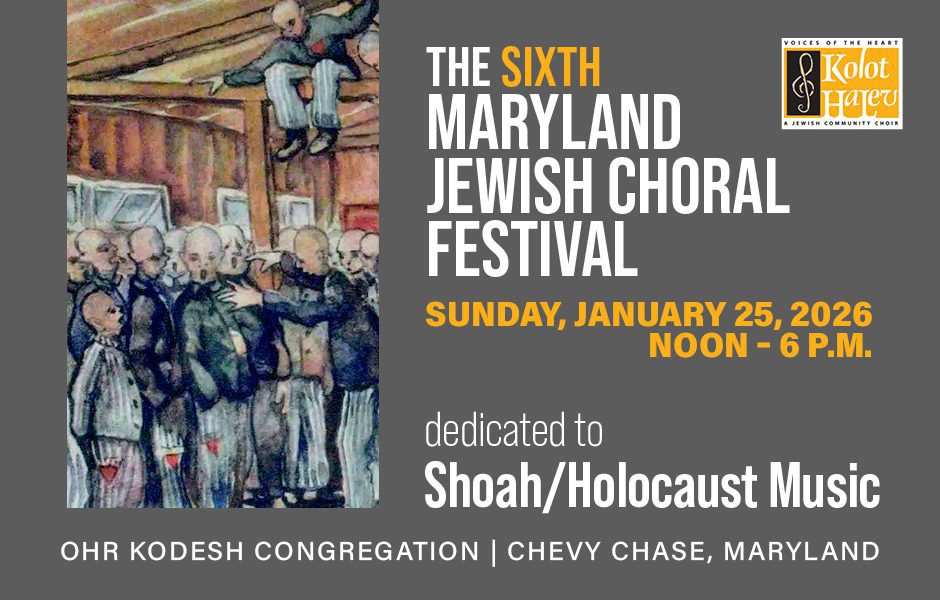
Dedicated to Shoah/Holocaust music. This choral event aligns with International Holocaust Remembrance Day on January 27th, which was designated by the U.N. to mark the anniversary of the liberation of Auschwitz-Birkenau, the largest Nazi concentration camp.
PHOTO: In 1942 in Dachau, an evening of song given by the Czechoslovakian camp choir was recorded in this drawing by Vladimir Matejka. The huge crowd enjoying this rare musical treat shows clearly how important it was for prisoners to be able to organize a musical performance like this (published in Kopf hoch, Kamerad! Künstlerische Dokumente aus faschistischen Konzentrationslagern, ed. Deutsche Akademie der Künste zu Berlin, 2d ed. (Berlin, 1966), ill. 21).
Difficulties in organizing musical groups were poor physical condition of the prisoners, language barriers among prisoners, the danger of being discovered, personnel changes due to deportations, and the lack of instruments and sheet music; it was often necessary to organize these secretly, or to play from memory.
These difficulties made it all the more important for professional and amateur musicians to set an example of solidarity and humane behavior in their dehumanized surroundings. This meant, of course, that there was less emphasis on aesthetic criteria: through fostering a sense of community, music served instead as a form of cultural resistance, as practical assistance in the struggle to survive.