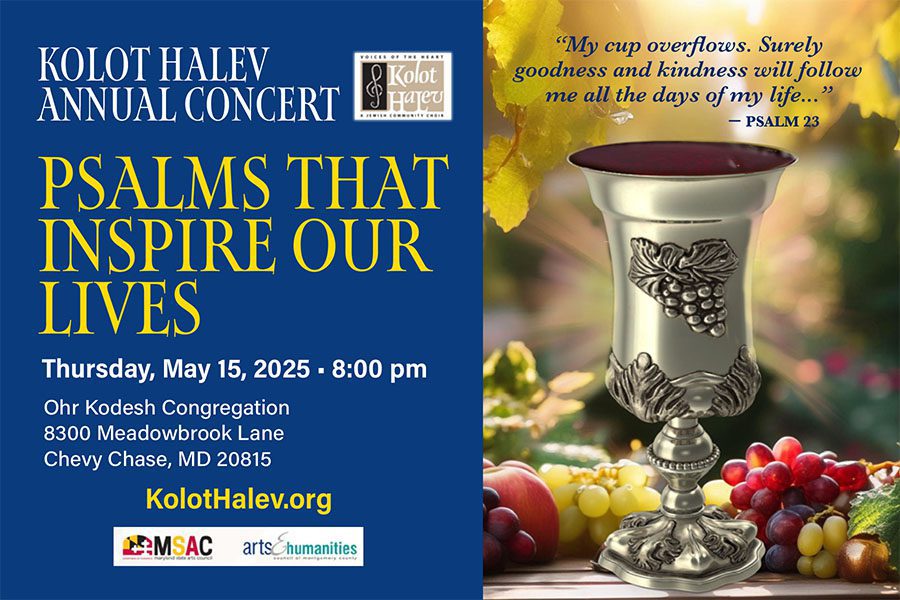
Psalms that Inspire Our Lives is a presentation of choral selections drawn from the Psalms. Since time immemorial, the Psalms have covered a wide range of emotions and inspired music from many traditions. Kolot HaLev will present music that provides moments of inspiration, passion, introspection, and beauty. We will feature contemporary composers as well as traditional melodies.
Hazzan Dr. Ramón Tasat, Artistic Director
Psalms that Inspire Our Lives
Thursday May 15, 2025, 8:00 p.m.
Ohr Kodesh Congregation, Chevy Chase, MD
Bar Yohai Shim’on Ibn Lavi Morocco
Bar Yohai Shim’on Ibn Lavi R. Tasat
Shir haMa’alot Psalm 126 P. Minkowsky
Karen Lantner, Roanne Pitluk, Soprano soloists
Laura Ariovich, Robyn Robbins Alto soloists
Alan Goldhammer, David Smith Tenor soloists
Louis Lantner, Steve Marcus Bass soloists
Mizmor le David Psalm 29 M. Bolaffi
Mizmor le David Psalm 29 E. Jonas
I Cieli Immensi Narrano Psalm 19 B. Marcello
’Al Naharot Babel Psalm 137 S. Rossi
Mi Ya’ale Psalm 24 N. Brooks
Kosi Revaya Psalm 23 S. Gold
Enosh Psalm 103: 15–17 L. Lewandowski
’A Zekharanu Yevarekh Psalm 115 D. Nowakowsky
Steve Marcus Bass soloists
Min HaMetzar n.1 Psalm 118 J. F. Halévy
Karen Lantner, Roanne Pitluk, Soprano soloists
Sylvia Horwitz, Mary Mihalyi Alto soloists
David Feuer, Alan Goldhammer, David Smith Tenor soloists
George Henschel, Louis Lantner, Steve Marcus, Josh Rose Bass soloists
Allel d’Italia Psalm 117 Amsterdam
Vi hi no’am Psalm 90 G. Henschel
Halleluya, Halelu ’Avdey A’ Pyyut for Hallel Irak/Calcutta
Halelouyah Psalm 150 C.-V. Alkan
Halelujah Shimrit Or K. Oshrat
Laura Ariovich, Mary Mihalyi Alto soloists
David Feuer, Tenor soloist
George Henschel Bass soloist
Yevarekhekha Psalm 128 D. Vinkrantz
Bar Yohai
Composed by Shim’on ibn Lavi (XVI c.) who, having fled as a child from the Spanish Inquisition, arrived in Fez, Morocco, where he remained until 1549. He later set out for Eretz Israel, stopping in Tunis, where he remained as the community’s teacher till his death in 1588. It is written in honor of the “Godly Tanna,” Rabbi Shimon Bar Yohai. It is sung in Sephardic Jewish communities on Shabbat. On Lag BaOmer, it is sung by most Jewish communities.
בַּר יוֹחַאי נִמְשַׁחְתָּ אַשְׁרֶיךָ שֶׁמֶן שָׂשׂוֹן מֵחֲבֵרֶיךָ
Bar Yohai, nimshahta ashrekha, shemen sasson me-haverekha
Bar Yohai! You were anointed—you are fortunate—with oil of joy from your fellows.
Psalm 126—Shir HaMa’alot
This is a song of praise about the time of the final redemption, which, when it arrives, will make the previous experiences of suffering seem like a mere dream. The past will then be understood differently, revealed as a period of toil and preparation for the ultimate reward. Psalm 126, with its theme of hope and redemption, was proposed as the Israeli national anthem, but “Hatikvah” (The Hope) was the final choice.
Shir HaMa’alot was set to music by Cantor Pinchas Minkowsky (1859–1924). Minkowsky’s well-known melody was popularized by Cantor Yossele Rosenblatt (1882–1933). Rabbi Tzvi Hersh Weinreb, in his commentary to Psalm 126, [The Koren Tehillim (2015)] says: “The great cantor, Yossele Rosenblatt, recommended our psalm to be the national anthem of the State of Israel. He popularized a stirring melody for it, composed by Pinhas Minkowski, which expresses its theme dramatically, and one which is suitable as an anthem for a redeemed nation. To this very day, many sing the words of our psalm to his melody.”
Psalm 29—Mizmor le David
This is a hymn about God’s greatness and His revelation in the world: Each one is termed “the voice of the Lord.”
As the trend to incorporate Western art music into the synagogue further increased at the beginning of the 19th century, the tenure of composer Michele Bolaffi (1768–1842) as musical director can be considered a turning point in the development of choral and instrumental music at the Great Synagogue of Livorno. Bolaffi was world-renowned; he served as musical director to the Duke of Cambridge, toured in Germany, and was in the service of Louis XVIII as a church musician in France. Many of his synagogue compositions are preserved in two related manuscripts, copied by Aron Croccolo, a hazzan of the Livornese synagogue. Bolaffi also composed secular music, including an opera, Saul, a Misere for three voices and orchestra (1802), a sonetto on the death of Haydn (1809) and many other short vocal pieces, including this well-known Psalm 29.
Emile Jonas (1827–1905) shared the Parisian theater billboards with the most prominent musicians during the second half of the 19th century. He was born into a Jewish family in Paris in 1827. In 1849 he received the Institut de France’s prestigious Second Grand Prix de Rome and in 1850, he was accepted as organist at the main synagogue. In 1854 he became the musical and choir director of the Portuguese Rite Synagogue. Its members, mostly from the Bordeaux and Bayonne communities, brought to Paris the customs and tunes of their ancestors, descendants of the conversos from Spain and Portugal. With the intention of preserving their musical patrimony, Jonas published, in 1854, Recueil de Chants Hébraïques à l’usage des Temples de Rite Portugais (Anthology of Hebrew Chants used at the Temples of Portuguese Rite). From the mentioned anthology Hazzan Tasat has chosen Jonas’ Psalm 29 and arranged it especially for Kolot HaLev.
Psalm 19—I Cieli Immensi Narrano
A psalm about creation, Torah, and man, it contains three seemingly unconnected parts that are revealed, ultimately, to be interrelated. One of the fascinating aspects of Jewish music in the Italian Renaissance is that just as Jewish composers like Salamone Rossi brought the music of the church to the synagogue, some Christian composers, likeBenedetto Marcello, brought the synagogue to the church.
The Venetian-born Marcello (1686–1739) led a dual career as a politician and noted composer of Italian church music. In his masterpiece, Estro poetico-armonico (1724–1727), a setting of the first 50 psalms for voices, figured bass, and various instrumental soloists, he drew directly on contemporary Jewish religious music for inspiration. In search of traces of the lost music of antiquity, he turned to the Venetian Jewish community, transcribing and setting some 11 Hebrew melodies from the Tedesco tradition (Italian Jews of Ashkenazi descent), including I cieli immensi narranofrom Psalm 19, that he believed derived from the ancient Temple in Jerusalem. In his score, he carefully printed them from right to left to follow the logic of the Hebrew language.
Psalm 137—’Al Naharot Babel
This psalm is an elegy about people in exile who are in a state of utmost decline and humiliation. It contains reminiscences of the destruction of Jerusalem as well as a prayer that punishment be meted out to the enemy. In Renaissance Mantua, Jews achieved a remarkably successful synthesis between their ancestral Hebraic culture and that of their secular environment. The Hebrew language was revived, and used in poetry and literature. A considerable musical figure in any context, Salamone Rossi was a singer, violinist, and composer at the court of Mantua from 1587 to 1628.
He was a Jewish composer who proudly appended to his name the word “Hebreo” (Salamone Rossi the Jew). His first published work, in 1589, was a collection of 19 canzonets—short compositions for three voices with dance-like rhythms and amorous texts. But Rossi’s most daring innovations were his synagogue compositions. Since the beginning of the last diaspora, musical instruments were banned from the synagogue as a sign of mourning for the destruction of the ancient holy temple. New melodies of gentile origin were considered a deviation from the pure Near-Eastern tradition and were forbidden. Change was discouraged, prayer tunes were kept in their original form, and no harmonization was allowed. But times changed and Rossi was the first Jew ever to compose, perform, and publish polyphonic settings of the synagogue liturgy for mixed choir.
In 1630 the city of Mantua was invaded by Austrian troops, the Jewish ghetto was ravaged, and its inhabitants fled. Choral music was no longer heard in the synagogue. Salamone Rossi probably died that year and was all but forgotten. Some 200 years later Baron Edmond de Rothschild, while on a trip to Italy, stumbled on a strange collection of old music books bearing the name Salamone Rossi Hebreo. Intrigued by what he found, Rothschild gave the manuscripts to Samuel Naumbourg, Cantor of the Great Synagogue of Paris. In 1876 the first modern edition of Rossi’s music was published.
Psalm 24—Mi Ya’ale
Who will ascend God’s mountain? This hymn depicts two modes of entrance: The contrast between human beings entering the Holy Temple versus the majestic arrival of God. Dr. Norma Brooks composed her first melody in 1984 and continues to compose melodies as musical gifts to friends and family in honor of key events in their lives. After the melodies spread to congregations across the United States, 14 of the songs were recorded on a CD, Your Bountiful Light, and collected in a companion book. A Harvard-trained clinical psychologist, Brooks lives in the Washington, D.C. area, and performs and teaches her music in workshops, lectures, and concerts across the United States.
Psalm 23—Kosi Revaya
This is a psalm of devotion, in which the psalmist envisions himself as a lamb, wholly reliant on his devoted shepherd. The lamb trusts that the shepherd will lead him on a secure path and provide him with a dwelling in a good and happy place. Verse 5 concludes with the words “kosi revaya” (My cup overflows”) that we will sing together.
Rabbi Shefa Gold is a leader in Aleph: Alliance for Jewish Renewal, and the director of The Center for Devotional, Energy, and Ecstatic Practice. She composes and performs spiritual music, has produced 10 albums, and her liturgies have been published in several new prayer books. The combination of her grounding in Judaism with a background in Buddhist, Christian, Islamic, and Native American spiritual traditions makes her uniquely qualified as a spiritual bridge celebrating the shared path of devotion. She is the author of “Torah Journeys: The Inner Path to the Promised Land” among other publications. Kosi Revaya is one of the many chants that she has created throughout many decades.
Psalm 103—Enosh
The first of two consecutive psalms beginning with the phrase “Bless the Lord, my soul,” Enosh deals mainly with the vicissitudes of human life, in both the physical and the spiritual realms. It also contains words of praise and supplication. Louis Lewandowski (1821–1894) contributed greatly to the liturgy of the synagogue service. His most famous works were composed during his tenure as musical director at the Neue Synagoge in Berlin and his melodies form a substantial part of synagogue services around the world today. Lewandowski was the principal founder of the Institute for Aged and Indigent Musicians.
Psalm 115—A’ Zekharanu Yevarekh
This is a song of thanksgiving, the concluding psalm of the Hallel prayer. In part, it describes how an individual person was rescued by God, but it also a model for the nation, since the individual happens to be their sovereign. Many of its verses praising God are written in responsive form.
A musical gem, David Novakovsky’s A’ Zekharanu Yevarekh was intended for congregations to sing during festival services. Today, it is rarely sung in synagogues and is largely performed at choral concerts. This is a shame, because choral music of this caliber could profoundly enrich our worship. We hope that in performing this piece, we, in some way, can help revive the Jewish choral liturgical tradition.
Psalm 118—Min HaMetzar n.1
This is a psalm expressing thankfulness that Israel enjoyed the privilege of choosing God. Jacques Fromental Halévywas born in Paris, the son of a cantor, Elie Halfon Halévy, the secretary of the Jewish community of Paris, a writer, and a Hebrew teacher. He entered the Paris Conservatoire in 1809, and in 1819 won the Prix de Rome. In 1820 he was commissioned to compose a Marche Funèbre et De Profundis en Hebreu that brought him to public attention. With his opera La Juive, in 1835, Halévy gave the world a work that was to be one of the cornerstones of the French repertory.
Halévy, who counted George Bizet among his students, composed Min HaMetzar n.1, (From the depths I call You, Yah). This dramatic setting of Psalm 118 follows the Romantic music style with marked contrasts, dynamics, and textures that depict the emotions emanating from the text.
Psalm 117—Allel d’Italia
This is one of the Psalms sung during Hallel, a service of praise. Allel d’Italia originates in Amsterdam and is structured in two sections. It begins with a recitative (Halelu et A’) that calls on listeners to praise God. The second half (Hodu laA’ ki tov), more lyrical, invites us to thank the Creator of the Universe for God’s endless lovingkindness.
Psalm 90—Vi hi no’am
“May Adonai’s favor be upon us and make the work of our hands endure.” This psalm deals with the human condition and man’s relationship with God. It includes elements of praise, complaint, and entreaty. We thank dear Kolot HaLev member George Henschel, who has dedicated this composition to Kolot HaLev. This is the premiere of his work.
Hallelu, Haleulu ’Avdey A’
This piyyut (religious poem) originated in the Iraqi Jewish community and later migrated to Calcutta. It is sung during the Hakkafot on Simhat Torah.
The song follows an alphabetical acrostic and enumerates divine attributes of the Holy One: “Blessed of the Blessed, Ancient of the Ancients, Righteous of the Righteous.” The refrain is taken from the opening line of Psalm 113.
הַֽלְלוּיָהּ ׀ הַֽלְלוּ עַבְדֵי ה’ הַֽלְלוּ אֶת־שֵׁם ה’
Hallelujah, hallelujah, Hallelu avdei Adonai
Psalm 150—Halelouyah
The concluding psalm of the book of Tehillim (Psalms), the text calls on everyone to praise God in all ways, with our voices and musical instruments.
The French-Jewish composer of Halelouyah, Charles-Valentin Alkan (1813–1888), was a virtuoso pianist. At the height of his fame in the 1830s and 1840s he was, alongside his friends and colleagues, Frédéric Chopin and Franz Liszt, among the leading pianists in Paris. Alkan earned many awards at the Conservatoire de Paris, which he entered before he was six. Although he had a wide circle of friends and acquaintances in the Parisian artistic world, including Eugène Delacroix and George Sand, from 1848 he began to adopt a reclusive life style, while continuing with his compositions. Alkan’s attachment to his Jewish origins is displayed both in his life and his work. He was the first composer to incorporate Jewish melodies into classical music. Fluent in Hebrew and Greek, he completed a new translation of the Bible into French. After his death, Alkan’s music was neglected, supported by only a few musicians. Starting in the late 1960s, many pianists have brought his music back into the repertoire.
Hallelujah was composed by Kobi Oshrat with Hebrew lyrics by Shimrit Or. In 1979, The Israel Broadcasting Authority accepted the song for its national selection for the 24th edition of the Eurovision Song Contest. The singing group, Milk and Honey, was formed specifically for the national selection. On March 31, 1979, the Eurovision Song Contest was held at the International Convention Center in Jerusalem and Israel won the contest.
Psalm 128—Yevarekhekha
A hymn that predicts blessing in the form of tranquility, while offering praise for those who fear God. I am truly blessed. I work hard, but productively. I love my wife. I am proud of my children. If Jerusalem was at peace, all would be perfect.
Yevarekhekha, composed by David Vinkrantz, was performed by Ilana Rovina for the 1970 Chasidic Song Festival and is now considered a classic.